
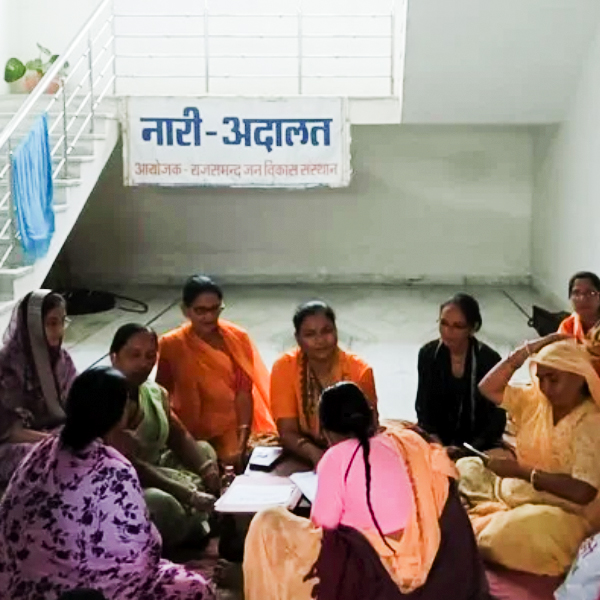
Nari Adalat Ensures Family Reconciliation
Nari Adalat (Women’s Court) has emerged as an effective community platform for addressing domestic violence and family disputes through dialogue and justice-oriented support.
A woman from Amet, here referred to as “Dashini,” registered a complaint in the Nari Adalat on 20 June 2025. She had been facing continuous domestic violence and emotional abuse in her marital home. For two to three months, she had been staying at her parental home due to severe distress.
In her complaint, she described being harassed over trivial issues such as accusations about eating before others, not cooking “properly,” or not eating with the family. She was often stopped from speaking to her mother. Whenever she visited her parents, the child was forcibly taken away from her, and upon her return, she was falsely accused of abandoning her child. Whenever she tried to raise her voice or request official action, her in-laws threatened her with divorce and custody loss.
A hearing of the Nari Adalat was organized on 2 July 2025, where the complainant narrated her entire experience. The case was handled with patience and empathy. Through three rounds of counselling sessions, both parties were invited and encouraged to express their concerns openly.
The Nari Adalat members actively facilitated dialogue, mediated tensions, and consistently followed up. Their balanced approach created a space for mutual understanding and accountability.
As a result, the dispute was successfully resolved. The woman returned to her marital home with her husband and child, reaffirming her right to dignity and safety within the family.
This case demonstrates that community-led justice mechanisms, like the Nari Adalat, play a crucial role in addressing domestic violence, preventing escalation, and rebuilding relationships through mediation, counselling, and women-centric support. It reinforces the belief that collective action and grassroots legal empowerment can transform lives and strengthen family harmony.